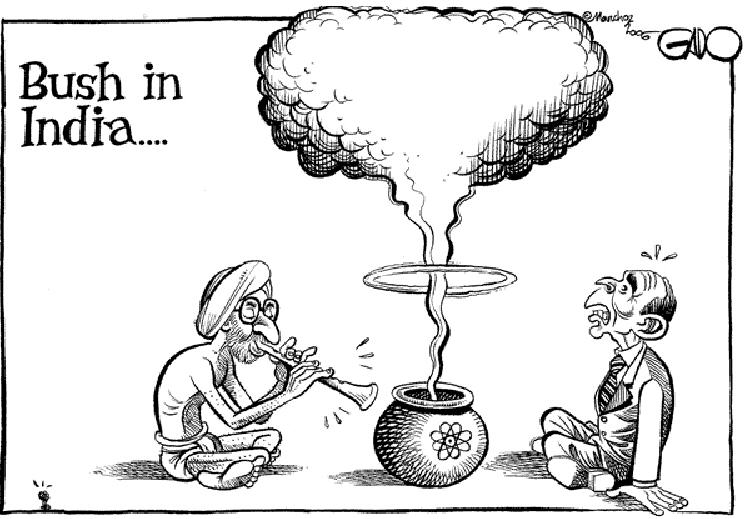
MTS Systems, an advanced components engineering firm has plead guilty to helping sell components for weapons systems to two companies that are directly involved in the weapons components of the Indian government's nuclear program. As typical of the ramifications of the 14th Amendment, the corporation itself has been allowed to plead guilty to falsifying documents, as though it was an abstract organization that was pushing people to lie to avoid export licensing requirements. Apparently, the human element, though failed, is not to be held accountable.
The story is complicated by "Co-conspirator A," an unnamed diplomatic official in the Indian Mission in Washington, D.C. This official tie is involved through a Singaporean businessman, who is facing 5 years in jail as a result of his role in the twisted scandal. I'm sure there's a lesson about race and fairness to be found there, but is not integrally important to the story.
Sure, the U.S. counterintelligence is kind of a joke and many countries are always stealing our knowledge and intellectual property, but then again, how easy is it to keep an idea under lock and key? This will only further serve to strengthen opposition to the deal in the U.S., although that might not matter at this point.
In a new twist, the White House is almost appearing the most reasonable party involved in the latest geopolitical saber rattling, or flashpoint, developing as Venezuelan troops are reportedly completely deployed in three regions along the Columbian border, aside from invoking the word terrorism in defense of the Columbian military raid into Ecuador. The matter is further complicated by assertions that FARC was dealing in Uranium. After all, no military adventure is too costly when defending the world against Weapons of Mass Destruction. There is a qualitative difference in this tension, though, as it is being complicated by an arms deal. In this case, the vaunted F-16 would have been sold to Venezuela from Spain, had it not been for a veto from the United States. Secretary of Defense Gates is comfortable in the ability of the Columbian military to handle their own affairs. This is hardly the first time that there has been tension along this border, as observable by the airstrips built into the road system in eastern Columbia. The investment community has signalled strong support for the Columbian side, pushing the Columbia's main stock exchange to the highest gain on world markets. As usual, the Wikipedia site on the incident is the most comprehensive.
In other news, Syrian and Saudi officials met in Cairo in an effort to relieve the tensions in the region, namely in Gaza, Iraq, and Lebanon. The Saudis then held discussions on the side with an American envoy. The USS Cole has been relieved off the coast of Lebanon by two U.S. warships and has passed through the Suez Canal en route to the Persian Gulf, signaling a wider build up of U.S. Naval forces in the region. The head of Egypt's Head of Intelligence, Omar Suleiman, has canceled a planned visit to Israel, perhaps reflecting a response to Ban Ki-Moon's letter, a denunciation of Israel's operations in the Gaza Strip, a snub at the U.S.-led bloc, or a combination of the three. Judging from the militaristic propaganda, and pondering minor war crimes to avoid major war crimes, Israel is ready to fight.
Does anyone remember Somalia? The United States has conducted another air strike there, which is sure to keep the fires of war still burning.
Tonight across the northern hemisphere the glorious light of the full moon was briefly occluded by the umbra of the earth. Red light, like the menstrual blood of a celestial goddess, flowed down on us and bedlam broke loose. For two hours, in two cities, the only sound the two authors of this post heard were the sirens of first responders scrambling madly to the next emergency. Wondering to themselves if this were really a Wednesday night. Then silence. The snow no longer reflecting the red power of that celestial orb. The darkness had passed and all that remains is the bright, familiar face of the moon. Her light, no longer simply taken for granted, but ignored as useless. - Th'Dave
It's not often that there happens to be a full lunar eclipse. Somewhat less often, a superpower escalates a potentially dangerous situation involving more sophisticated weapons and a new generation of warfare. In case you were outside enjoying the eclipse and weren't glued to the TV, at 9:30 PM Central Standard Time, right about the time white rabbit peaked, the Lake Erie, an American Aegis-class destroyer shot down that satellite, despite warnings from Russia and China about escalating a new race to weaponize and control space. Not really space, mind you, rather those behind this weapons test with a very small tolerance for error would like to move strategic thinking into the orbits around our beloved Mother Earth. I don't watch TV, but the article above seems pretty media polished, so expect the mainstream news media to pick up this wonderfully nationalistic gem of a story in short order.
As an American citizen and a veteran, I understand the rationale behind developing weaponry and doctrine for future conflicts, but nothing happens in a vacuum. When the Chinese Military shot down an aging weather satellite and didn't announce it, the world was supposed to be incensed that there was an ulterior motive behind it, and more it seemingly was reflective of cold war thinking. However, other than press conference, the differences seem superficial. If nothing else, the rest of the world could easily interpret the move as standard 'tit for tat' testing, reminiscent of the Cold War. News at 7!
Perhaps the worst part of this entire episode, is that the military has demonstrated its ability to intercept objects moving just about a hair's breadth above the earth's atmosphere, moving at 17,000 miles per hour. Which are the operational requirements of the missile defense system, so also look to say that we should invest more in this pointless weaponizing of space against terrestrial threats. But those tens of seconds are very hard to replicate.
Surely, the apocalypse is nigh! (I hate arguing for him, but it would seem that Bill was taken out of context here.) - TheRedKap
As always, there is a firestorm of news and protest surrounding U.S. foreign arms sales. And, of course, the countries involved are potential flashpoints for future conflicts.
From Iraq comes news that the Defense Department is bolstering its foreign military sales staff in Baghdad. In a program that was already plagued with problems of corruption and mismanagement, the problems were further compounded when the program realized the ridiculous leap in funding levels, from $200 million to $3 billion in only one year. The corruption in the acquisition process already has the potential to sour relations with our NATO ally, Turkey, as weapons bound for Iraqi troops have showed up in the hands of militant fighters fighting for an independent Kurdistan. However, due to the personnel shortage that accompanied the increased workload, the Iraqi government was forced to buy weapons from other countries. Now, members of Congress reportedly want to know whether American money was used to buy Chinese weapons for the Iraqi Army.
Arms sales, in fact, also provide one of the main sticking points between the United States and China, mainly weapons sales to the island of Taiwan. The economic problems that are the most prominent in the domestic, national discourse in U.S. relations with the PRC have been "underlined by the U.S. for years." However, the issue of Taiwan and the foreign arms sales are the basis for the other point of contention between the two superpowers. In fact this year, Section 1206 in the National Defense Authorization Act of Fiscal Year 2007, the House of Representatives Armed Services Committee establishes some pretty firm policies. Emphasis has been added by author.
More importantly, the committee believes that maintaining a balance of power across the Taiwan Strait is critical to ensuring deterrence and preserving peace, security, and stability in Asia. China’s National People’s Congress adopted an anti-secession law that essentially authorizes China’s Central Military Commission to use non-peaceful means against Taiwan if the latter declares independence. The committee is concerned that this law, in conjunction with an excessive military build-up by China, may signal a weakening of deterrence across the Taiwan Strait. The committee believes that the exchange program, by helping to strengthen Taiwan’s defenses, would help preserve and strengthen deterrence, thereby encouraging China and Taiwan to resolve their differences peacefully.
Considering that Chinese military spending is growing to make the PLA one of, if not the, strongest land forces in the world, the logic of the policy is almost self-defeating. The amount of equipment and money necessary to maintain the vision of deterrence expounded by this doctrine is well beyond the means of the United States. Look for this policy to cause problems in the future, as the U.S. is left groping for a new tact to maintain the stability in the region that is so vital to the international shipping lanes. The real question that would help one in thinking of this problem is, what event could happen that would leap the PRC's political elite to abandon the current Nash Equilibrium enjoyed by all parties in the region, in favor of a military strike? To which, the U.S. is bound under law to look upon with "grave concern," as per the 1979 Taiwan Relations Act.
There is a new arms race brewing in South Asia, although not the usual type. In this case, the developed countries of the world are falling over themselves to provide India with the next generation of military equipment. Looking at potential spending reaching $40 billion dollars, it's not hard to imagine why countries would feel interested in the competition. Nicholas Burns, the Undersecretary of State for Political Affairs feels so strongly about the subject of U.S.-Indian ties that he wrote an article for the current issue of Foreign Affairs. I particularly enjoy who he actually tries to make the article sound sincere in believing that ideology trumps the buying power of the Indian rupee. Again, the subtext to the entire discussion is long-term ties with India, in the fact of a emerging threat from China in Asia.
Before going onto the next topic, enjoy a little video goodness.
Now, the JDAM is going on sale to countries in the Gulf region, specifically Saudi Arabia, which has caused quite a bipartisan reaction on Capital Hill. One should consider, though, that Israel and its lobby aren't protesting the sale in and of itself, only the fact that sales of this type reduce the strategic and technological edge enjoyed that enforced deterrence and brought stability to the region. The sale is practically dead on arrival.
Finally, in Pakistan, an assassin has taken the life of former Prime Minister Benazir Bhutto, but that shouldn't stand in the way of ever-stronger ties developing between the U.S. and Pakistan. In particular, this event will not interfere in anyway with the proposed $2.1 billion arms deal in progress. Pakistan is slated to purchase18 F-16s of the C and D variants.
The end result of all of this is that American foreign policy, especially in the case of Pakistan, is being pulled into a cycle of arming one side to counter another threat that may or may not be of its own creation. And while arms sales and military relations reach new highs, things such as civil society and rule of law tend to be left by the way side. The Military Industrial Complex isn't exactly a democratic institution, after all. Those who are in a strong position to regulate this very important facet of foreign policy are focusing on other priorities, to say the least. Instead of controlling the number of arms distributed internationally, they are worried about the transfer of sensitive information, and the ramifications of Globalization on the MIC, but more on that later.
These days there's been a lot of mention of the problematic relationship between the US and China. However, in new developments, the People's Liberation Army is reportedly seeking military nuclear cooperation with the United States. Which enemy do we have in common? Here's a brief background of the latest complications between the Eagle and the Dragon. Here, a pundit from the BBC stumbles through a discussion in the economic problems that have recently surfaced in the form of toy recalls, and at the end interestingly equates it to the military problems. Here, another pundit from the Economist raises the theory that the PLA is not necessarily under direct control of the Party's political leaders. The PLA, of course, has enjoyed a rather privileged position in the hierarchy of power, given it was the proving ground for the first generation of CCP leaders, restored order after the Cultural Revolution, and suppressed the 1989 Tiananmen Square incident. Considering the anti-satellite test, it could mean that the PLA feels entitled to more of a free hand in deciding policy and weapon acquisitions.
Normally I'm not one for dispensing punishment on anyone based on what may or may not be misguided social regulation, but this case makes me tend towards that whole eye for an eye thing. I'm repulsed that the military protects its officers to such an extent as to allow this waste of flesh to get off with only two years in a deep dark hole that is military prison.
Christians are also adopting Bush's mode of cooperating with congress. That is, not. How rich do you think they are? Sen. Charles Grassley would like to find out.
Consider this as indicative of the overall situation of the military, the war in Iraq, and the unfortunate enlisted volunteers.
Clearly, the military is almost desperate for people if they are speaking of individual soldiers and their skill sets as "investments." Not to say that every single soldier isn't expensive, but they are having problems recruiting and retaining people and those who have already suffered are suffering more "papercuts."
Around 700 people have gone through just Walter Reed to be treated for serious injuries involving the loss of a limb, not to mention thousands of others who have suffered severe burns and traumatic head injuries. The War in Iraq, due to the nature of the weapons involved has become one of the most brutal bloodbaths in history, and with each side continuously re-inventing the bomb, the death toll stands to climb higher. But, as some may say, the insurgents are fighting a guerrilla war, trying to best us through ten thousand papercuts.
Despite the fact that many of these injuries have cost these men and women their lives livelihoods, they are not especially cared for in the manner that most Americans would expect. The individual Army of One is not particularly significant in and of him or herself, indeed to the impersonal military bureaucracy that is the Department of Defense, their losses are only so many papercuts.
First, These people dont deserve a special meeting with the Secretary of State, anymore than a random grouping of 6 citizens, or worse 6 corporate execs. The heads of government should not be having listening sessions where they allow special religious intrests air their opinions on non-religous issues. I know they think its a religious issue but thats the problem. There are enough people in the administration that think they need to bring on the rapture and the end of the world. Remember, in these peoples minds the end of the world is a good thing. It gets them to God faster.
For those of you who may be worried about the state of research into military hardware in the world can rest easy. Even though the world's largest and most expensive military is essentially sleeping at the wheel, one man has seen the future and wishes to bring the fifth generation of warfighting technology to humanity. No one but Vladimir Putin would have the foresight to build a "grandiose" nuclear defense complex and new Intercontinental Ballistic Missiles. Not to mention, bringing other countries, such as India, on board to help development of combat fighters that are even better than the Sukhoi SU-34. Glory to the Motherland.