Showing posts with label Military Industrial Complex. Show all posts

Wednesday, February 04, 2009

Obama and the Military Industrial Complex


In the first few weeks of the Obama Administration, it is becoming increasingly clear that he can't please everyone. Unfortunately, some in the military establishment have gone almost to the point of blackmail in attempting to place controls on U.S. Defense Policy.

With the word "stimulus" in the air, and every corporation with operations in the United States smelling bacon, an effort has emerged in Washington seeking to extend production of the F-22 as a sort of stimulus spending. A webpage sponsored by manufacturer Lockheed-Martin alleges that 95,000 jobs can be saved by continuing to manufacture the F-22 Raptor, without mentioning a specific cost in additional military spending. Undoubtedly, the Air Force itself is hoping for this increase as well, considering reports that the F-35 can't stand up against Russian air defense systems. However, this is the least of Obama's military problems.

Adm. Mike Mullen, Chairman of the Joint Chiefs of Staff, acknowledging the change of focus for the Defense Department from Iraq to Afghanistan, has a laundry list of potential military problems which are very far-reaching.

For instance, [Adm. Mullen] said, the United States needs to help Iran develop stability instead of fomenting terror.

Other sticking points abroad, Mullen said, are assuring stability in places like Russia and China, dealing with issues like famine and genocide in Africa, and the drug trade in Mexico.


This news report on Adm. Mullen's full lecture is well-worth reading. Obviously, the Department of Defense is going to be on the receiving end of a lot of government funding, especially considering the costs of expanding operations in Afghanistan, despite efforts to curb U.S. strategic objectives.

Two other reports regarding the military-industrial complex could serve as an early test of the new administration. The first, that the military is attempting to accuse Obama of reducing military spending, by not giving them all that the Joint Chiefs of Staff wanted, smacks of career military officials attempting to establish their role in crafting defense policy. While bureaucratic squabbling is hardly anything new, this second report, is far more disturbing. If senior military officials are truly attempting to pressure Pres. Obama into accepting a misleading plan to rename apples oranges, they are certainly making a political decision instead of respecting the orders of their new Commander-in-Chief.

Defense policy, especially spending decisions, are fundamentally political decisions, and thus the exclusive province of elected civilian leaders. Even if General Petraeus is worried that he is losing his hotline to the White House that he enjoyed in the days of the Bush Administration, it would probably be more useful for him to pursue a good working relationship with the incoming administration, rather than engaging in bureaucratic in-fighting over issues which have already been addressed.

Thursday, October 02, 2008

The M.I.C. Rumbles On

With another new week comes another new round of notifications to Congress from the DSCA about new arms sales to various countries, mostly friendly, but others perhaps less so. Moral questions abound surrounding the sales of military weapons to various regimes throughout the world, not the least of which being whether a country can afford the expenditure, but perhaps more importantly, whether the weapons will be used to crush opposition, as may be the case in Kenya. It might also be the case that the 33 T-72's were bound for South Sudan, for the purpose of re-newing the civil war. Interfering with the transfer of arms, of course, is a dangerous game, and will probably not end well.

In Taiwan, the lack of arms sales are much more of a controversy. The Taiwanese government is being vexed by inter-department review in the Bush Administration of its desired arms package. Currently, the brouhaha is boiling down to a game of fingerpointing between the GMT and the former ruling party the DPP. Either way, this type of arms sales, including heavy duty equipment such as attack helicopters and surface to air missiles would certainly force the People's Republic of China to take notice and be concerned.

Sunday, September 14, 2008

The Department of Defense: We Deliver Weapons to the World


[Note: This posting was authored by TheRedKap, who is currently behind the Great Fire Wall, and is unable to post directly.]

For those of you at home who are worried that the American economy is crumbling beyond repair, take heart in the fact that the United States is still the arms supplier to the world. All of the usual types of equipment are involved, namely the M-16 assault rifle, the F-16 in various configurations, and the C-17 military transport plane. However, there are a few new surprises. For instance, the United Arab Emirates is reportedly considering purchasing Black Hawk helicopters and Hellfire anti-tank missiles.
Details of the record $32 billion year enjoyed by the Pentagon include a package of various weapons systems to countries in the Persian Gulf region. But, don't worry, all of these weapons are going to our friends, such as an advanced missile defense system for the aforementioned U.A.E., helicopters and tanks for Saudi Arabia and Egypt, , and most interestingly technology to help Jordan secure its border with Iraq. Iraq, soon to be flush with billions of dollars in oil revenue is in the market for modern military equipment, including F-16s, armored vehicles, attack helicopters, and mortar systems. An upgrade to the PAC-3 and munitions for Israel is also in the works, along with at least 25 F-35 Joint Strike Fighters, with options for up to 50 more, with an eye to getting the planes to the IDF "as quickly as we possibly can."
Meanwhile, Russia's 21% of global arms sales, which partly go to Iran and Syria, were recently characterized by the Israeli Ambassador to Washington, Sallai Meridor as "dangerous and destabilizing to Israel and for peace in the region." Sure, the US and Israel were cooperating with the Georgian military prior to the recent 5 Day War, to the tune of $300 million dollars last year alone, but clearly the Russians were unjustified in their reaction to the Georgian offensive into South Ossetia and Abkahzia. The ambassador, for his part, couldn't understand why anyone would see these arms supplies as threatening or destabilizing. Looking through the old crystalline prism of spheres of influence, the Russians are very concerned about the threat upon its borders.
Do not be confused into thinking that these arms sales are entirely funded by the recipients of these weapons systems. The U.S. government, according to numbers from the BEA, spent approximately $3.8 billion dollars in the first quarter of 2008 financing foreign military sales. While this may be a drop in the bucket compared to the monthly deficit our government is currently running, such as the $111.91 billion dollar deficit for the month of August, arms sales are the classic example of foreign diplomacy that has the biggest potential for unintended catastrophic results.

Monday, May 12, 2008

Bush Seeks Coalition Against The Troops


Since the run-up to the war in Iraq anyone who has questioned the Bush administration has had to endure ad hominem attacks on their patriotism and accusations that they don't support the troups. But it has been the Bush administration that has failed to support the troops. If you are like me, when Rumsfeld attempted to justify the lack of adaquate but available armor plating on hum-vees, you were so overcome with rage that you passed out half way through the press conference. The hypocracies and outrages continue even in these late hours of the dark years of the Bush administration as the President has promised to veto an expansion of the GI Bill.


This is particularly significant in relation to war profiteering, the topic an earlier posting on this very blog. The members of the administration who ducked out of military service and their friends and business associates rake in the cash while overcharging the government on essentials for the troops, telling the manufacturers not to include available additional armor, force wounded soldiers to live in decrepid conditions, and deny expansion of the GI bill. When the government is being overcharged here its you and I that are being screwed in the pooper.


These soldiers have taken it on the chin from this administration and continue to step up and volunteer to serve this country. It is a true testiment to the indominable spirit of the United States soldier.

Saturday, May 10, 2008

War and Business as Usual


When one learns of phenomenal profits reaped by elected officials during their tenure, the typical reaction isn't necessarily one of disgust. However, when one learns that several officials personally profited off of W's decision to go to war, any American citizen who claims to 'support our troops' should be incensed. Incredibly, to belabor the point with an altogether morbid and tragic twist, the fact that 2004 Democratic Presidential nominee Sen. John Kerry of Massachusetts, one is left simply flabbergasted.

Why, after all, should the voters attempt to disregard an individual's rational choice? If the decision is presented that one must vote against or otherwise hinder and impede a potentially illegal invasion of another country yet lose billions of dollars (and counting) in the process, or wave a flag and cash the checks, the voters should not expect much.

Clearly, many American politicians are in the business of war, but how much of this business is really in the public interest?

Friday, March 14, 2008

The Indian Nuclear Deal: Counterintuitive Counterintelligence Complications


MTS Systems, an advanced components engineering firm has plead guilty to helping sell components for weapons systems to two companies that are directly involved in the weapons components of the Indian government's nuclear program. As typical of the ramifications of the 14th Amendment, the corporation itself has been allowed to plead guilty to falsifying documents, as though it was an abstract organization that was pushing people to lie to avoid export licensing requirements. Apparently, the human element, though failed, is not to be held accountable.

The story is complicated by "Co-conspirator A," an unnamed diplomatic official in the Indian Mission in Washington, D.C. This official tie is involved through a Singaporean businessman, who is facing 5 years in jail as a result of his role in the twisted scandal. I'm sure there's a lesson about race and fairness to be found there, but is not integrally important to the story.

Sure, the U.S. counterintelligence is kind of a joke and many countries are always stealing our knowledge and intellectual property, but then again, how easy is it to keep an idea under lock and key? This will only further serve to strengthen opposition to the deal in the U.S., although that might not matter at this point.

Friday, March 07, 2008

Whom We Serve

154,000, which is only a rough estimate. How many more veterans are just scraping by, living in the margins of our society? How many have been forced to impose upon the good natures of their family? How many of them are still battling demons from America's wars for empire?

There is a wide disparity in the quality of military service, as one might expect, almost correlated to the disparity of resources nations devote to their national defense. But, beyond the perceptions that the news media conveys, there is a further disparity within military ranks, between officer and enlisted. In professional military services, the enlisted soldier is treated with respect from his superiors and not commonly regarded as the piece of government property he or she is. In some countries, professional enlisted personnel serve as personal servants to the officer corps. In the worst examples, military service is little more than forced labor, where soldiers are beaten or worse, there is not much of an institutionalized retirement plan. Here, in the United States, we can take something of a moral high ground, compared to groups like the Interahamwe. Here, we grant our veterans education benefits and the like, if they are not rendered dysfunctional by wartime injury, such as amputation or post-traumatic stress disorder.

A look at the last hundred years of the wartime Presidents also reveals something of a trend. For instance, one of the key leaders in the foundation of the American Empire, Theodore Roosevelt, aside from the contempt he held for those not so blessed to be white, had never actually served in the military until the beginning of the war. Perhaps the reason he was not given the Congressional Medal of Honor until after his death was for having pushed into a military battle without having been ordered to do so. Just a thought.

Woodrow Wilson, who also brought us the Federal Reserve System, was an intellectual and academic, who also had never spent a day in a military uniform before leading the nation into WWI.

Franklin Delano Roosevelt, a corporate lawyer before entering public service, similar never served any kind of military service.

Harry S. Truman, who was a WWI Artillery Officer, also brought us nuclear warfare and the policy of containment. In addition to his role in the recognition of Israel and Pakistan, he laid the groundwork for the Cold War and tried to bring the whole of the Korean peninsula under Western influence.

Lyndon Baines Johnson, holder of the most disgusting example of a military award I've ever seen, brought us the Gulf of Tonkin incident and the subsequent escalation of the Vietnam War, which, in Vietnam, is known as the American War. Perhaps it should be known as Johnson's War.

Ronald Reagan
, an actor before becoming a politician, brought a new type of escalation, spending billions of dollars fighting proxy wars and beginning a new arms race involving ballistic missile interceptors.

Which brings us to W. I don't really feel as though I need to say too much about his military record.

In summation, the leaders and defenders of the Free World, those most rabid about the defense and expansion of the U.S.' national sovereignty, almost without exception have never picked up a gun at a range and thought about how to justify to himself seeing the form of another human being in his gunsights and pulling the trigger. After all, a warrior seeks to conserve his strength and continue living, and thus should fight as little as possible. Unfortunately, the toll of these wars is paid by those who fight, either draftees or volunteers, who often seem to be tragically discarded by those for whom they served.

For those who want a visual representation of America's War Dead, try this.

Thursday, March 06, 2008

154,000!


Sometimes its hard to keep up the necessary level of Rage to continue blogging about politics.  It gets tiring.  Then, I hear something like this.  

154,000 United States veterans are homeless!

What the fuck!  Thats un-fucking-acceptable!  These people dedicated years of their lives to serve us.  They put their lives on the line to protect us.  They enlisted with the promise of a better life and a leg up on the future, and now they are the wards of the fucking VA who can do little more than count them.  This is the definition of a miscarage of justice.  They deserve a minimum gurantee of housing, food, and medical care for life.  

Friday, February 29, 2008

doublespeak


Senator John McCain, the presumptive Republican nominee to the presidential election, has single handedly made America less safe. It may seem like a stretch to say, but how else would one characterize the way he single-handedly prevented the Air Force from awarding its refueling tanker to Boeing? Instead, Airbus will assemble parts at an assembly plant in Mobile, AL, ala the disaster that Boeing itself encountered in trying to build the 787 Dreamliner on schedule. In truth, this is just the end result of colossal corruption scandals and bureaucratic bungling, and the American taxpayers are getting trampled underfoot as various parties move into position to reap as much profit as possible.

In more conceptual terms, this move could represent the Military Industrial Complex beginning to cannibalize its own pieces as it begins to come to terms with its own unsustainable nature. And so, another 100 year cycle comes to an end. My favorite quote is from Gen. Lichte, who apparently regards the economic concerns as trivial, or of tertiary importance.

At a news conference, Air Force officials said that the creation of domestic jobs was not a factor in the decision. In response to questions about possible negative reaction to the deal in Congress, Gen. Arthur J. Lichte, head of the Air Force’s Air Mobility Command, said, “This will be an American tanker, flown by American airmen with an American flag on its tail and, every day, it will be saving American lives.”

Thursday, February 28, 2008

Guns by the Ton


Defense Secretary Robert Gates just finished a six day tour of Asia, selling weapons systems to India and Indonesia, primarily, completely ignoring Pres. Eisenhower's warning. (posted at bottom)

In a speech given to Indonesian Council on World Affiars (part 1 and part 2), Sec. Gates emphasized the role of Indonesia in leading the region, while affirming the U.S.' role as arms dealer. Since normalizing military ties in 2005, the Indonesian military has benefited from increasingly generous military subsidies, in an effort to compete with Vladmir Putin's 2007 negotiations. In particular, the Department of Defense has begun using "1206" authority and the Global Train and Equip program to help bolster Indonesian military capabilities against a supposed terrorist threat. Although I don't see what naval installations and F-16s have to do with fighting individual extremists.

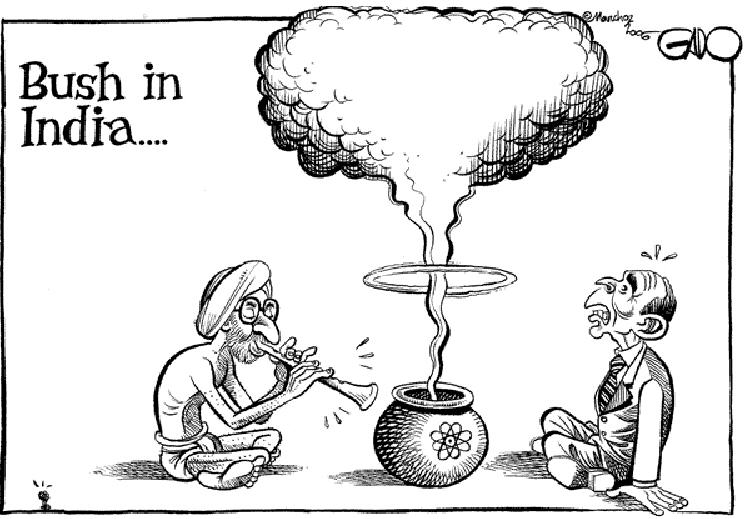
In nuclear India, Sec. Gates sought expanded military ties, along with, as you might have guessed, more arms sales. Besides the much sought after F-16, negotiations are also reportedly underway to include India in the missile defense shield that the Pentagon is trying to set up around Asia. This foreign policy of trying to be allies with both India and Pakistan at the same time is going to come to a head at some point. The longer the establish waits to produce productive changes in policy, the more violent the anti-U.S. backlash in Pakistan. Any worries about how a dangerous arms race could emerge between the two largest emerging economies in the world, stem from overlooking the inherently profitable nature of arms races, as each side tries to outdo the other in expenditures of treasure.

In another sign of attempting to graft foreign governments into our informal empire and the machinery that powers it, the Iraqi Army is switching from the AK-47 to the M-16. Besides the obvious cultural and political ramifications of this, between spare parts and replacements, arms manufacturers in the United States stand to make a big pile of money off of this.

Two of these arms manufacturers are reporting profits based on foreign military sales. Boeing (NYSE:BA) and Raytheon (NYSE:RTN) might as well be paying the salary of the SecDef for as much as he contributes to their bottom lines. After all, there would be little money to invent better ways to drop bombs if no one was willing to buy them.

For some additional background information, here is an article about the world's military industrial complex, and the Western world's role in it, which is about 75% of the total by value. And, of course, long overdue, the speech that coined the phrase Military Industrial Complex.

Wednesday, February 27, 2008

Geopolitics: What Goes Bump in the Night


What is a threat? Is it a lone suicide bomber or a million man army on a hair trigger? The basis for this thought exercise, of course, is the size and quality of one's own forces. The quality and status of the American Armed Forces is beyond the scope of this current exercise, though. Therefore, for our purposes, we will assume that the U.S. is indeed the hyperpower beyond compare. So what is the biggest threat to the national security of the United States?

Pentagon general counsel William J. Haynes II feels not obtaining convictions in the military tribunals of terrorist suspects held in Guantanamo Bay's Camp X-Ray would be a threat to our national security. Former head of the prosecution of these prisoners, Air Force Col. Morris Davis, on the other hand, feels that opaque justice is the only way to see justice done. Even if these men were released today, how much would they still believe in the cause after up to six years of the strictly regimented and austere lifestyle afforded by Camp X-Ray's accommodations. I would be willing to bet that most of them would just go home and try to live out the rest of their lives trying to cope with what they've been through.

While Iraq may not be our 53rd state yet, the presence of 140,000 American troops means that our government throughout our continued presence in country will be forced to consider the security ramifications of a country in the middle of the most dangerous region of the world. So what a twisted web we weave when one of our NATO allies, Turkey, is potentially threatening the viability of the state that we're trying to carve out of the remnants of Saddam Hussein's regime. While the Bush administration characterizes the actions of the Turkish government as being responsible, this escalation will invariably agitate other regional powers, and stoke fears that Turkey seeks to impose its own order over Kurdistan.

Another threat that the Bush Administration is keenly aware of is the potential legal ramifications of the application of the Bush Doctrine. Thus, while Iran is alleged to pose a very real nuclear threat, members of the Coalition of the Willing are meeting to write and produce the 'third strike' resolution against Iran, ala the prequel to the invasion of Iraq. This incident smacks of another leading problem in the administration of the American National Security strategy, the human element of information interpretation. Documents the U.S. is using as the "smoking gun" are, predictably, be denounced as complete forgeries by the Iranian government. Curveball told the administration everything that they needed and wanted to hear about Iraq's illicit weapons programs, the accuracy of this information was criticized at the time by German Intelligence, and later by every other respectable intelligence agency that was worthy of the name. Remember this? Perhaps the thinkers in the Administration aren't creative enough to come up with another method to draw the world into another conflict that will further destabilize the energy infrastructure the world economy relies on. At any rate, there probably will be a third UN Resolution denouncing Iran. The reason for this is that the UN Security Council is about the only organization in the world that can legitimately overrule Iran's right to a peaceful nuclear energy program under the Nuclear Nonproliferation Treaty.

One of the most dangerous positions in the world, though, is to be without friends. Thus, Defense Secretary Robert Gates, the best salesman for the Military Industrial Complex, is touring Asia, and is currently enjoying two days of talks with Indian leaders. While the stalled nuclear deal will only be tangentially discussed, one can be sure that the U.S. Military's involvement in Pakistan and India's recent sea-based missile test will be near the top of the agenda, beneath promoting weapon sales. While military relations may be the goal of this trip, see China's agreement to release information on American POWs, one has to wonder whether this will actually be realized with the white elephant of historical tensions between Pakistan and India in the room. The lingering question, though, is whether the United States can successfully balance punishing Iran for violating the NPT while at the same time rewarding India with a nuclear agreement that will allow it to continue to develop nuclear weapons and delivery platforms.

Russia's First Deputy Prime Minister and presidential candidate, Dmitry Medvedev, warned in a campaign speech that the U.S. is placing Europe in a difficult position by recognizing Kosovo, yet is not taking any of the risk because of the intervening ocean. Given Russia's long term plans for Serbia, expect this issue to remain prickly.

But, of course, everyone knows that killer robots will be the primary threat of the 21st Century.

Wednesday, February 20, 2008

The Lunar Eclipse Of Blood


Tonight across the northern hemisphere the glorious light of the full moon was briefly occluded by the umbra of the earth. Red light, like the menstrual blood of a celestial goddess, flowed down on us and bedlam broke loose. For two hours, in two cities, the only sound the two authors of this post heard were the sirens of first responders scrambling madly to the next emergency. Wondering to themselves if this were really a Wednesday night. Then silence. The snow no longer reflecting the red power of that celestial orb. The darkness had passed and all that remains is the bright, familiar face of the moon. Her light, no longer simply taken for granted, but ignored as useless. - Th'Dave


It's not often that there happens to be a full lunar eclipse. Somewhat less often, a superpower escalates a potentially dangerous situation involving more sophisticated weapons and a new generation of warfare. In case you were outside enjoying the eclipse and weren't glued to the TV, at 9:30 PM Central Standard Time, right about the time white rabbit peaked, the Lake Erie, an American Aegis-class destroyer shot down that satellite, despite warnings from Russia and China about escalating a new race to weaponize and control space. Not really space, mind you, rather those behind this weapons test with a very small tolerance for error would like to move strategic thinking into the orbits around our beloved Mother Earth. I don't watch TV, but the article above seems pretty media polished, so expect the mainstream news media to pick up this wonderfully nationalistic gem of a story in short order.

As an American citizen and a veteran, I understand the rationale behind developing weaponry and doctrine for future conflicts, but nothing happens in a vacuum. When the Chinese Military shot down an aging weather satellite and didn't announce it, the world was supposed to be incensed that there was an ulterior motive behind it, and more it seemingly was reflective of cold war thinking. However, other than press conference, the differences seem superficial. If nothing else, the rest of the world could easily interpret the move as standard 'tit for tat' testing, reminiscent of the Cold War. News at 7!

Perhaps the worst part of this entire episode, is that the military has demonstrated its ability to intercept objects moving just about a hair's breadth above the earth's atmosphere, moving at 17,000 miles per hour. Which are the operational requirements of the missile defense system, so also look to say that we should invest more in this pointless weaponizing of space against terrestrial threats. But those tens of seconds are very hard to replicate.

Surely, the apocalypse is nigh! (I hate arguing for him, but it would seem that Bill was taken out of context here.) - TheRedKap

Thursday, December 27, 2007

Tons o' Guns

As always, there is a firestorm of news and protest surrounding U.S. foreign arms sales. And, of course, the countries involved are potential flashpoints for future conflicts.

From Iraq comes news that the Defense Department is bolstering its foreign military sales staff in Baghdad. In a program that was already plagued with problems of corruption and mismanagement, the problems were further compounded when the program realized the ridiculous leap in funding levels, from $200 million to $3 billion in only one year. The corruption in the acquisition process already has the potential to sour relations with our NATO ally, Turkey, as weapons bound for Iraqi troops have showed up in the hands of militant fighters fighting for an independent Kurdistan. However, due to the personnel shortage that accompanied the increased workload, the Iraqi government was forced to buy weapons from other countries. Now, members of Congress reportedly want to know whether American money was used to buy Chinese weapons for the Iraqi Army.

Arms sales, in fact, also provide one of the main sticking points between the United States and China, mainly weapons sales to the island of Taiwan. The economic problems that are the most prominent in the domestic, national discourse in U.S. relations with the PRC have been "underlined by the U.S. for years." However, the issue of Taiwan and the foreign arms sales are the basis for the other point of contention between the two superpowers. In fact this year, Section 1206 in the National Defense Authorization Act of Fiscal Year 2007, the House of Representatives Armed Services Committee establishes some pretty firm policies. Emphasis has been added by author.


More importantly, the committee believes that
maintaining a balance of power across the Taiwan Strait is critical
to ensuring deterrence and preserving peace, security, and stability
in Asia. China’s National People’s Congress adopted an anti-secession
law that essentially authorizes China’s Central Military Commission
to use non-peaceful means against Taiwan if the latter declares
independence. The committee is concerned that this law, in
conjunction with an excessive military build-up by China, may signal
a weakening of deterrence across the Taiwan Strait. The committee
believes that the exchange program, by helping to strengthen
Taiwan’s defenses, would help preserve and strengthen deterrence,
thereby encouraging China and Taiwan to resolve their differences
peacefully.


Considering that Chinese military spending is growing to make the PLA one of, if not the, strongest land forces in the world, the logic of the policy is almost self-defeating. The amount of equipment and money necessary to maintain the vision of deterrence expounded by this doctrine is well beyond the means of the United States. Look for this policy to cause problems in the future, as the U.S. is left groping for a new tact to maintain the stability in the region that is so vital to the international shipping lanes. The real question that would help one in thinking of this problem is, what event could happen that would leap the PRC's political elite to abandon the current Nash Equilibrium enjoyed by all parties in the region, in favor of a military strike? To which, the U.S. is bound under law to look upon with "grave concern," as per the 1979 Taiwan Relations Act.

There is a new arms race brewing in South Asia, although not the usual type. In this case, the developed countries of the world are falling over themselves to provide India with the next generation of military equipment. Looking at potential spending reaching $40 billion dollars, it's not hard to imagine why countries would feel interested in the competition. Nicholas Burns, the Undersecretary of State for Political Affairs feels so strongly about the subject of U.S.-Indian ties that he wrote an article for the current issue of Foreign Affairs. I particularly enjoy who he actually tries to make the article sound sincere in believing that ideology trumps the buying power of the Indian rupee. Again, the subtext to the entire discussion is long-term ties with India, in the fact of a emerging threat from China in Asia.


Before going onto the next topic, enjoy a little video goodness.


Now, the JDAM is going on sale to countries in the Gulf region, specifically Saudi Arabia, which has caused quite a bipartisan reaction on Capital Hill. One should consider, though, that Israel and its lobby aren't protesting the sale in and of itself, only the fact that sales of this type reduce the strategic and technological edge enjoyed that enforced deterrence and brought stability to the region. The sale is practically dead on arrival.

Finally, in Pakistan, an assassin has taken the life of former Prime Minister Benazir Bhutto, but that shouldn't stand in the way of ever-stronger ties developing between the U.S. and Pakistan. In particular, this event will not interfere in anyway with the proposed $2.1 billion arms deal in progress. Pakistan is slated to purchase 18 F-16s of the C and D variants.

The end result of all of this is that American foreign policy, especially in the case of Pakistan, is being pulled into a cycle of arming one side to counter another threat that may or may not be of its own creation. And while arms sales and military relations reach new highs, things such as civil society and rule of law tend to be left by the way side. The Military Industrial Complex isn't exactly a democratic institution, after all. Those who are in a strong position to regulate this very important facet of foreign policy are focusing on other priorities, to say the least. Instead of controlling the number of arms distributed internationally, they are worried about the transfer of sensitive information, and the ramifications of Globalization on the MIC, but more on that later.

Thursday, December 06, 2007

Military Industrial Complex


Despite there being no threat of a nuke from Iran, Bush wishes to rush ahead with the European Missile Shield. Not to mention, it pisses Russia off. Through all this the old media never mentions the miliary industrial complex.
http://en.wikipedia.org/wiki/Military_industrial_complex