The Large Hadron Collider is the biggest and most powerful super collider in the world and humanity hopes to discover new fundamental truths about reality through its use. It was built in France and Belgum but there was once the possibility that an even bigger, more powerful collider would have been built in the U.S. except congress lost the nerve to fund the project after already dumping millions into partial construction. This was not just a loss to the local community and the University system of Texas but to U.S. education. Now the best and brightest minds in physics will be compelled to go to France instead of being drawn to America. New discoverys will be made that will lead to marketable technologies that could have been discovered within U.S. jurisdiction. The loss of talent and potential discovery and the immesurable loss to the U.S. economy is particularly irksome in the current economic crisis. This shortsitedness reflects a general U.S. failure to focus on quality of science education in order to maintain our technological and intellictual superiority in the world.
[Note: This posting was authored by TheRedKap, who is currently behind the Great Fire Wall, and is unable to post directly.]
For those of you at home who are worried that the American economy is crumbling beyond repair, take heart in the fact that the United States is still the arms supplier to the world. All of the usual types of equipment are involved, namely the M-16 assault rifle, the F-16 in various configurations, and the C-17 military transport plane. However, there are a few new surprises. For instance, the United Arab Emirates is reportedly considering purchasing Black Hawk helicopters and Hellfire anti-tank missiles.
Details of the record $32 billion year enjoyed by the Pentagon include a package of various weapons systems to countries in the Persian Gulf region. But, don't worry, all of these weapons are going to our friends, such as an advanced missile defense system for the aforementioned U.A.E., helicopters and tanks for Saudi Arabia and Egypt, , and most interestingly technology to help Jordan secure its border with Iraq. Iraq, soon to be flush with billions of dollars in oil revenue is in the market for modern military equipment, including F-16s, armored vehicles, attack helicopters, and mortar systems. An upgrade to the PAC-3 and munitions for Israel is also in the works, along with at least 25 F-35 Joint Strike Fighters, with options for up to 50 more, with an eye to getting the planes to the IDF "as quickly as we possibly can."
Meanwhile, Russia's 21% of global arms sales, which partly go to Iran and Syria, were recently characterized by the Israeli Ambassador to Washington, Sallai Meridor as "dangerous and destabilizing to Israel and for peace in the region." Sure, the US and Israel were cooperating with the Georgian military prior to the recent 5 Day War, to the tune of $300 million dollars last year alone, but clearly the Russians were unjustified in their reaction to the Georgian offensive into South Ossetia and Abkahzia. The ambassador, for his part, couldn't understand why anyone would see these arms supplies as threatening or destabilizing. Looking through the old crystalline prism of spheres of influence, the Russians are very concerned about the threat upon its borders.
Do not be confused into thinking that these arms sales are entirely funded by the recipients of these weapons systems. The U.S. government, according to numbers from the BEA, spent approximately $3.8 billion dollars in the first quarter of 2008 financing foreign military sales. While this may be a drop in the bucket compared to the monthly deficit our government is currently running, such as the $111.91 billion dollar deficit for the month of August, arms sales are the classic example of foreign diplomacy that has the biggest potential for unintended catastrophic results.
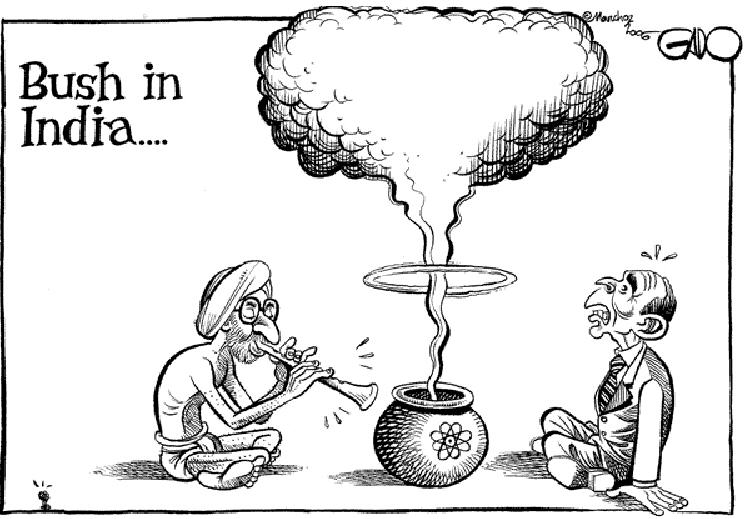
MTS Systems, an advanced components engineering firm has plead guilty to helping sell components for weapons systems to two companies that are directly involved in the weapons components of the Indian government's nuclear program. As typical of the ramifications of the 14th Amendment, the corporation itself has been allowed to plead guilty to falsifying documents, as though it was an abstract organization that was pushing people to lie to avoid export licensing requirements. Apparently, the human element, though failed, is not to be held accountable.
The story is complicated by "Co-conspirator A," an unnamed diplomatic official in the Indian Mission in Washington, D.C. This official tie is involved through a Singaporean businessman, who is facing 5 years in jail as a result of his role in the twisted scandal. I'm sure there's a lesson about race and fairness to be found there, but is not integrally important to the story.
Sure, the U.S. counterintelligence is kind of a joke and many countries are always stealing our knowledge and intellectual property, but then again, how easy is it to keep an idea under lock and key? This will only further serve to strengthen opposition to the deal in the U.S., although that might not matter at this point.
Defense Secretary Robert Gates just finished a six day tour of Asia, selling weapons systems to India and Indonesia, primarily, completely ignoring Pres. Eisenhower's warning. (posted at bottom)
In a speech given to Indonesian Council on World Affiars (part 1 and part 2), Sec. Gates emphasized the role of Indonesia in leading the region, while affirming the U.S.' role as arms dealer. Since normalizing military ties in 2005, the Indonesian military has benefited from increasingly generous military subsidies, in an effort to compete with Vladmir Putin's 2007 negotiations. In particular, the Department of Defense has begun using "1206" authority and the Global Train and Equip program to help bolster Indonesian military capabilities against a supposed terrorist threat. Although I don't see what naval installations and F-16s have to do with fighting individual extremists.
In nuclear India, Sec. Gates sought expanded military ties, along with, as you might have guessed, more arms sales. Besides the much sought after F-16, negotiations are also reportedly underway to include India in the missile defense shield that the Pentagon is trying to set up around Asia. This foreign policy of trying to be allies with both India and Pakistan at the same time is going to come to a head at some point. The longer the establish waits to produce productive changes in policy, the more violent the anti-U.S. backlash in Pakistan. Any worries about how a dangerous arms race could emerge between the two largest emerging economies in the world, stem from overlooking the inherently profitable nature of arms races, as each side tries to outdo the other in expenditures of treasure.
In another sign of attempting to graft foreign governments into our informal empire and the machinery that powers it, the Iraqi Army is switching from the AK-47 to the M-16. Besides the obvious cultural and political ramifications of this, between spare parts and replacements, arms manufacturers in the United States stand to make a big pile of money off of this.
Two of these arms manufacturers are reporting profits based on foreign military sales. Boeing (NYSE:BA) and Raytheon (NYSE:RTN) might as well be paying the salary of the SecDef for as much as he contributes to their bottom lines. After all, there would be little money to invent better ways to drop bombs if no one was willing to buy them.
For some additional background information, here is an article about the world's military industrial complex, and the Western world's role in it, which is about 75% of the total by value. And, of course, long overdue, the speech that coined the phrase Military Industrial Complex.
Among the many questions surrounding China's economic development and the associated environmental problems, there is rarely any question of responsibility. As the Chinese Communist Party maintains a firm control over all policy measures, it's easy to point the finger and say that they bear all responsibility. However, a couple of recent articles, one from the New York Times and the other from the Wall Street Journal, might lead one to slightly more nuanced conclusions.
The article from the New York Times, describes how Germany, suddenly left without coal to power its industrial juggernaut, sold off the pieces of industry to parties in China. German politicians were able to point at a blue sky and the profit off of the sales and benefit politically, while the factories were set up in China to keep producing the black soot that nearly destroyed the Black Forest.
The article from the Wall Street Journal illustrates Canada's role in the Three Gorges Dam project. In a similar vein, then-Prime Minister Jean Chretien leveraged deals to provide turbines to the project to keep his native province of Quebec from seceding from the confederation.
These stories, if nothing else, should provide anecdotal evidence that policy makers need to consider the ethical implications of international trade. These facilities are still polluting at the same rate, if not more, than they were for their previous owners, and yet they were sold anyway, instead of cleaner alternatives. Are ethical obligations limited to boundaries and citizenship?
If nothing else, these cases provide further evidence that one can make money through immoral business practices. Moral hazard theorists be damned!
In other environmental news from the Middle Kingdom, Beijing recorded its 256th "blue sky day" of the year. Pollution is squarely on the agenda for the next five years, with a new Politburo getting settled into office. Also making news is a website (English, 中文) from the Institute of Public & Environmental Affairs detailing air pollution.