Showing posts with label moral hazard. Show all posts

Friday, April 03, 2009

Ben Franklin Report: The Mark to Market Rule

The Colbert ReportMon - Thurs 11:30pm / 10:30c
The Word - Fine Line
comedycentral.com
Colbert Report Full EpisodesPolitical HumorNASA Name Contest


As if in direct response to Colbert's challenge to create something, anything to believe in to turn the recession around, the Financial Accounting Standards Board changed the Mark to Market rule. Unfortunately this was actually in response to intense pressure from Congress and the Banks. This lets banks revalue their toxic assets before reporting them on their books. (Which makes me wonder why this was done just after the end of the first quarter.) The banks that took on more risk than they could manage don't just get to value these assets at whatever they want, they get to value these pieces of steaming crap at whatever they think someone would pay if anyone was interested in buying a steaming pile of shit just because someone called it golden.

Of course this looks exactly like what we have been doing so far in relation to this banking fiasco. We looked at the disaster and saw that the people in charge had established a system of perverse incentives that encouraged highly risky acts and called them extremely safe because of a complete lack of regulation. Our response has been to give even more huge shit tons of cash these very same people that fucked us for fun and profit and by removing any other regulation that insists we call a spade a spade. I am finding it harder and harder to resist the urge to call for murderous mobs to converge on Wall Street.

The Wall Street response to the reduction of regulation was obvious. Though, two years ago, if you said that Dow 8,000 would be good news people either would have thought you were crazy or they would have been terrified.

In this article, John Berry tries to criticize the negative reaction to the rule change that I outlined above. But he is comparing apples to oranges when he says,
The family doesn’t have to put up money to cover the difference between the mortgage and the lower market value. Nor should the Atlanta bank have to take a big hit on its reported income because some other mortgage-backed securities owner sold in a depressed market.
He is comparing the effect on banks that have to back their lending by having 10% of that value on their balance sheets. Which of course home owners don't do. And the family that is upside down on their mortgage will have to pay that money on the mortgage that is more than the value of their home just because they bought at the wrong time.

Lots of pundits and apologists for the financial industry keep trying to accuse home owners that face loosing their residence of buying beyond their means. Through this argument they try to push some of the moral culpability for this fiasco on people who only wanted a nice house. They didn't buy above their means, they listened to the market. The market told them what they were worth. It's not their fault the market lied to them because they couldn't have understood the market. Seriously, if huge banks couldn't see this coming when they specialize in finance, then its simply irrational to accuse home buyers of wrongdoing just because the effect of their actions is to further reduce the property value of their neighbors.

Berry does make a legitimate point about the removal of reality in accounting. He asserts that the Atlanta bank he is referring to in the above quote intends to hold on to its mortgage backed securities until they mature. Meaning the bank will be getting all the money from the mortgagees. This is the family in his apples to oranges scenario who has to pay the full value of the mortgage even though the house is worth less. (But hey, at least it still provides the same amount of warmth and shelter. Its just that breakfast nook they added doesn't mean they can afford to send the kids to college.) This means that the banks assets are really worth nearly their full value because the bank will get paid what it originally bargained. So the accounting rule lets them value their assets at what they can reasonably expect to still get paid over 30 years and they can lend out more money to consumers and businesses which increases liquidity and gets the markets moving again and leads to more manufacturing, more jobs, and more spending. Everyone's happy.

Except that just brings us back to where we started last November. No one knows how many mortgages will go into arrears or how many will be devalued through the proposed new bankruptcy rules. The short of it is we don't know if the mortgage backed securities will be worth what they were originally bargained for in 30 years when they run their course. All we do know is that they will be worth less. If not become worthless.

Friday, November 07, 2008

The Real Cost of the Bailout


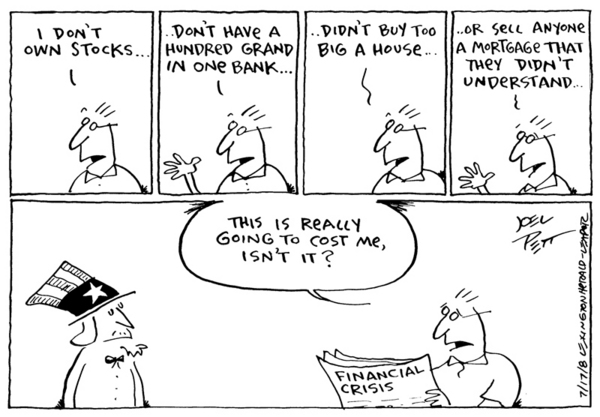
As I've written here on this blog before, our public policy has come closer and closer to engendering moral hazards. Now, this statement has come to a sick and twisted fruition. The cause of this putried flowering is the confluence of two individual factors. The first, is President-elect Barack Obama's pledge to help the ailinig auto industry. Already bleeding money like it needs a tournequet and considering passing another series of economic stimulus packages, the deficit is already such a theoretical number that adding to it won't make much of a difference. The second is another set of behaviors that, besides the aforementioned moral hazard, are morally questionable in other ways. General Motors is burning cash like it's needed to power plant machinery lost $7.35 per share in its latest report. Furthermore, this cash crunch is putting the company in the position where it will no longer be able to fund regular operations. However, instead of consider options like marginal spending decreases, or bankruptcy, the consequences of which CEO Rick Wagoner says would be "dire", he is waiting for President Obama to pull out the checkbook and write a check to the auto industry. After all, the financial industry is in the process of receiving checks without any strings attached, so why shouldn't the Big Three, also? I'm sure Rick is also already beginning to plan how he is going to spend the bonus that he no doubt will feel he earned because he drove the company into the ground so hard and fast that the government needed to bail it out or face political consequences.  Herein lies the moral hazard and the real cost of the Emergency Economic Stabilization Act. Instead of engaging in normal business practices that would help shore up the bottom line, such as closing additional plants and laying off hourly workers, or even declaring bankruptcy and arresting the further deterioration in its credit rating, a company that is potentially too big to fail, is probably going to be able to get a handout from the federal government. So, instead of receiving the punishment of the markets for not balancing its liabilities and assets properly, and for not developing products that the public is willing to purchase, a company is instead able to receive the public's money in the form of a handout, probably without any strings attached.  

Monday, October 06, 2008

The Ben Franklin Report: The Bailout Settles In


Just in case you need a reference point to how much the bailout was, consider the number to the right, the cost of the War in Iraq thus far. Yes, the bailout that was passed last week surpasses the amount of money spent on that mistake by leaps and bounds. So, when history is written, how should this period be judged? Where were our priorities? Did we ensure that every child in America had access to primary health care? Were we more concerned about finding a cure for cancer, or spending money on making sure that phone calls and emails didn't contain terrorist-related content?


The bailout and its effects in the market place, in a nut shell. Apparently, today the chaos continues as the first market to open after Bush's signature, the Israeli Tel Aviv Stock Exchange tumbled like a rock going down a sheer slope. 

The fundamental source of the entire financial crisis has been the opaque nature of the books of the biggest financial institutions. The fact that they refused to value assets which, if shown in the light of day, would be revealed to have little revenue potential, will probably end up costing the companies billions in dollars is only being papered over by the bill that the various branches of the federal government approved on Friday. This is further reinforced by new rules from the Securities and Exchange Commission stating that corporations no longer have to price these assets on a 'mark-to-market' basis. That is to say, they no longer have to value them at the price they would likely fetch in a free and open market, but rather can just pencil in whatever they want and use these assets as capital, or as collateral for the various short-term lending programs offered by the Federal Reserve. However, the hanging $55 trillion question in the air is what happens when the Credit Default Swaps start becoming unbundled. For instance, you may remember A.I.G. which met its fate and an $85 billion bailout from the Federal Treasury because of these insurance policies, but has yet to sell a single asset, despite blowing through $61 billion of the money provided in the bailout. Yet their executives party like Nero in Rome. Party on, Wayne. Why worry when none of those responsible for the lending practices will ever be prosecuted

So, with some banks saying that they won't even participate in the No Bank Left Behind program and banks that will still fail regardless of their participation, what are we left with? A budget problem that will hamstring the domestic and foreign policies of the next President, whoever it may be, an IRS with undercover investigative powers which will be on the prowl to make sure that every dollar Uncle Sam has coming is brought to the Treasury, and good, old-fashioned rage almost everywhere other than Wall Street. 

Thursday, September 25, 2008

I made you an economy but I broked it.


If any of you are regular readers you may be wondering why these last two weeks have gone without a posting on the economy. There are several reasons. First, our senior economic analyst, TheRedKap is still stuck behind the Great Firewall. Second, my political rage peaked about a year ago. After seven years of rising outrage at this administration I finally reached my limits and fizzled out somewhat.

I haven't been able to listen to Marketplace in almost a year so I have had to try and make sense of this stuff myself. Which is difficult for even economists to understand. If the voodoo priests of the dollar can't explain on whats going on, what hope does an average American have? Here is one thought I had yesterday which I hope is not so obvious that I appear foolish for taking the time to lay it out.

One economist yesterday likened the current $700 B...B...B...Billion Bailout to that scene from Blazing Saddles when Bart, played by Cleavon Little, holds a gun to his own head to keep the town from lynching him. Wall Street, here played by Henry Paulson, is holding the gun to its own head and saying they will pull the trigger if we don't save them from their own mistakes. That's pretty obvious but it's the first step. So, what caused this situation? Housing and real property values have risen astronomically bolstered by unfettered access to credit. People were given loans that they could never pay back and the sleaze bags that sold them these loans bunched them together to hide that they were bad investments and then gave them to ratings agency sleaze bags that told the whole world that this was some good shit. Then the poor people who were lied to about how much house they could afford in George Bush's "ownership society"start defaulting on their mortgages. Banks sit up and take notice and start forecasting falling profits and eventually losses and then admit that they don't know how many of these toxic mortgages are going to explode, but they have lots of em'. Opportunist investment bankers then short sell the stock of these banks. (Short selling is either complicated, or simple and commonplace depending on which economist you are talking to and their politics, but the basic explanation is investment bankers try to drive down the value of a stock in order to make a quick buck. They do this because they don't actually have jobs and don't contribute anything of value to society and can only destroy. Like little economic vampires in suspenders.)

So, you get to our current situation with overinflated housing values putting pressure on the markets because banks are so heavily invested in these things that aren't worth what they paid. Now they want the government, meaning the taxpayers, meaning you and me, to buy these worthless bundles of mortgages. They say this will set a bottom level price that they can always be sold to the government for, so that investors can never loose all the money they put into these mortgages, eliminating the mystery of whether the one they just bought will explode in their hands, thusly bolstering confidence in the market and loosening up credit so you and I can go back to buying 72" LCD TVs and leveraging our house to put a pool in our back yards. Thusly fueling the rampant over consumption that has fueled the economy.

Except maybe some of these banks should fail. Maybe an economy based on credit is inherently unstable. Maybe we shouldn't just go back to buying cheaply made garbage from overseas? Maybe these same people that have been pushing for deregulation and chanting the mantra of the free market, when suddenly faced with the terrifying face of the monster that is the free market, they let up a cry for socialism such that has not been heard since Lenin. These people who have played games with our retirement and destroyed the value of our employers and our homes want it both ways just as long as they don't have to feel the pinch. Analysts point out that CEO's of these failed banks are getting fired but mention golden parachutes to them and they begin to dissemble. It doesn't take an economics degree or an MBA to understand that if someone who made over a million dollars in income last year looses their job, they aren't going to loose their house or go hungry like the guy working down at the Ford plant in Cleveland, or the GM factory in Janesville. These guys on Wall Street are more out of touch with what middle class is then McCain. When was the last time an investment banker welded the bumper onto a car or pulled a ton of coal out of the Earth with only their sweat and muscle?

OK, I got distracted by class warfare there. Where does this $700 Bubble Burst Bailout Billion come from? It doesn't just come out of the ass of Johnny Taxpayer, it gets squeezed out of the value of the Dollar. What the markets and Paulson are asking congress to do is to transfer the overinflated value of housing and real property indirectly to the value of the dollar. Inflation. I am talking about inflation with a capital "I." The value of the dollar has been falling against other currencies over the course of this whole subprime crash and since commodities are pegged to the dollar it has fueled the rise in costs of oil and food and other basic essentials. So basically after destroying the value of our homes and companies, the Wall Street voodoo machine is going to destroy the value of our labor and the dollar. I think they are doing this because they know that their "labor" doesn't have any value.

Sunday, September 14, 2008

The Walk of Shame: Corruption and Government, Don't Look So Suprised


Apparently the tax law is so complex that even the guy in change of writing it doesn't understand his own obligations under that law. Or maybe he just forgot to report tens of thousands of dollars in income over two decades. Somehow, I think that if I made a similar mistake there would be gruff men in dark suits knocking on my door.

Speaking of money owed to the government. Days after the Interior Department received an award for high standards of integrity the Inspector General of the Interior Department issued a detailed report describing inappropriate conduct among the minerals management services who collect royalties from oil companies. The sordid dealings include contract fixing, inappropriate sexual relationships between regulators and oil company execs, and regulators being on the payroll of oil companies as consultants. The missing money comes in where the MMS has failed to pursue thousands of dollars in royalties owed to the government by the oil companies while they have been racking in record profits and growing fat off of huge tax subsidies. Subsidies which also don't seem to be doing anything to keep gas prices low. At least the "MMS Chicks" had a good time.

Pelosi seems to think this will effect the nature of the debates regarding increased offshore oil drilling. By which she doesn't mean that this information revealing that the Bush administration could have done something about the rising cost of oil will be used to take increased drilling off the table. (Drilling that wont do anything to reduce the cost of oil since it will take decades for there to be any production and that production will be so small as to not make any impact at the pump.) No, this will just result in some language being added to the bill regarding integrity. This new information won't change anything because it has already been decided to go ahead with drilling. In fact congress has decided to go ahead with a worse plan than that suggested by Paris Hilton.

Thursday, March 27, 2008

Ben Franklin Report: Questions, Questions Everywhere


Unfortunately, due to the arcane nature of economic measurements and a desire on the part of the elite to remain elite, there is an entire market around attempting to provide answers to clients and predict near- and long-term economic phenomena. So, in an effort to help you from wanting to go spend money on overpriced financial services, here are some questions you may be asking, and some answers.

  • How much will this crisis cost the economy in the long term? According to JP Morgan Chase, the overall costs could be as much as $1.2 trillion.
  • How is the crisis being felt in other markets? Europe's economy is resilient against the contagion, thanks to the rising Euro and sound monetary policy of keeping interest rates stable, which, in turn, draws available capital into the Eurozone. Head of the European Central Bank President, Jean-Claude Trichet remains skeptical if the worst has yet to come. Canada's CIBC still is working through at least $25 billion in exposure to monoline insurers.
  • Is there more unwinding yet to happen in bad loans? The simplest way to answer this would be to say, "Yes." However, as details are still emerging about the prevalence of home equity loans, or other liens placed on homes in addition to the traditional first lien, mortgages, there is still a lot of red ink to be spilled.
  • Is the stock market going to be a viable investment anytime soon? Perhaps, but not for the next few years. In the cyclical nature of business, the stock market traditionally sours for a decade after a decade of strong trading. So if this trend continues, the market will probably not begin to make lasting gains until approximately 2012.
  • With increasingly visible protests against financial corporations receiving bailouts from the Federal Government, are there any other potential targets of popular discontent? As all politics are local, one need look no farther than the financing of your local Wal-Mart. Does your local community allow 'tax increment financing?'
  • The employment outlook is souring, but was there any good news in the latest batch of GDP data? Not really, almost every number on the page is down in comparison to the quarter before, with a very precipitous drop in government spending. Also of note, exports are declining at the same time as imports are decreasing, which is a reflection of real consumer spending. Also of note, the value of real residential fixed investments, that of houses and such, fell by 25.2%.
  • With all of the concerns about moral hazard, is there really a bad way to intervene in the marketplace? Yes, there is. For instance, pushing Fannie and Freddie into buying bad loans and then holding more capital in reserve against this new volume of bad loans. Businesses and executives that made bad decisions need to face the consequences of their decisions. The government has enough work to do to get its own house in order. I'm not alone in thinking that with this bailout will come a spiraling dollar.

Monday, December 31, 2007

A Question of Origin

Among the many questions surrounding China's economic development and the associated environmental problems, there is rarely any question of responsibility. As the Chinese Communist Party maintains a firm control over all policy measures, it's easy to point the finger and say that they bear all responsibility. However, a couple of recent articles, one from the New York Times and the other from the Wall Street Journal, might lead one to slightly more nuanced conclusions.

The article from the New York Times, describes how Germany, suddenly left without coal to power its industrial juggernaut, sold off the pieces of industry to parties in China. German politicians were able to point at a blue sky and the profit off of the sales and benefit politically, while the factories were set up in China to keep producing the black soot that nearly destroyed the Black Forest.

The article from the Wall Street Journal illustrates Canada's role in the Three Gorges Dam project. In a similar vein, then-Prime Minister Jean Chretien leveraged deals to provide turbines to the project to keep his native province of Quebec from seceding from the confederation.

These stories, if nothing else, should provide anecdotal evidence that policy makers need to consider the ethical implications of international trade. These facilities are still polluting at the same rate, if not more, than they were for their previous owners, and yet they were sold anyway, instead of cleaner alternatives. Are ethical obligations limited to boundaries and citizenship?

If nothing else, these cases provide further evidence that one can make money through immoral business practices. Moral hazard theorists be damned!

In other environmental news from the Middle Kingdom, Beijing recorded its 256th "blue sky day" of the year. Pollution is squarely on the agenda for the next five years, with a new Politburo getting settled into office. Also making news is a website (English, 中文) from the Institute of Public & Environmental Affairs detailing air pollution.