Showing posts with label Global Economic Crisis. Show all posts

Wednesday, August 26, 2009

Beer prices rise for the Consumer as Costs of Production Fall and Profits Rise


A number of brewers announced recently that the price of beer that the consumer pays will be going up citing rising costs. In the CNN story above the reasons given are less vague. The brewers claim to be raising prices to offset rising commodity prices and fall in volumes. Though, commodity prices have fallen recently and have caused farmers and dairies to worry about staying profitable this year. Also, ten days ago Anheuser-Busch InBev announced that their second quarter profits had grown despite the drop in volume because of cost cutting measures. One has to work through the maze of business doublespeak in these non judgmental articles regarding price increase and increased profitability to understand that cost cutting and "synergies" in these cases refers to job cuts as a result of the InBev takeover of Anheuser-Busch.

If you are the kind of person who likes to buy American and support American jobs, it is getting harder and harder to find an economical beer. Though some of the big brewers still employ Americans.

Wednesday, February 04, 2009

Obama and the Military Industrial Complex


In the first few weeks of the Obama Administration, it is becoming increasingly clear that he can't please everyone. Unfortunately, some in the military establishment have gone almost to the point of blackmail in attempting to place controls on U.S. Defense Policy.

With the word "stimulus" in the air, and every corporation with operations in the United States smelling bacon, an effort has emerged in Washington seeking to extend production of the F-22 as a sort of stimulus spending. A webpage sponsored by manufacturer Lockheed-Martin alleges that 95,000 jobs can be saved by continuing to manufacture the F-22 Raptor, without mentioning a specific cost in additional military spending. Undoubtedly, the Air Force itself is hoping for this increase as well, considering reports that the F-35 can't stand up against Russian air defense systems. However, this is the least of Obama's military problems.

Adm. Mike Mullen, Chairman of the Joint Chiefs of Staff, acknowledging the change of focus for the Defense Department from Iraq to Afghanistan, has a laundry list of potential military problems which are very far-reaching.

For instance, [Adm. Mullen] said, the United States needs to help Iran develop stability instead of fomenting terror.

Other sticking points abroad, Mullen said, are assuring stability in places like Russia and China, dealing with issues like famine and genocide in Africa, and the drug trade in Mexico.


This news report on Adm. Mullen's full lecture is well-worth reading. Obviously, the Department of Defense is going to be on the receiving end of a lot of government funding, especially considering the costs of expanding operations in Afghanistan, despite efforts to curb U.S. strategic objectives.

Two other reports regarding the military-industrial complex could serve as an early test of the new administration. The first, that the military is attempting to accuse Obama of reducing military spending, by not giving them all that the Joint Chiefs of Staff wanted, smacks of career military officials attempting to establish their role in crafting defense policy. While bureaucratic squabbling is hardly anything new, this second report, is far more disturbing. If senior military officials are truly attempting to pressure Pres. Obama into accepting a misleading plan to rename apples oranges, they are certainly making a political decision instead of respecting the orders of their new Commander-in-Chief.

Defense policy, especially spending decisions, are fundamentally political decisions, and thus the exclusive province of elected civilian leaders. Even if General Petraeus is worried that he is losing his hotline to the White House that he enjoyed in the days of the Bush Administration, it would probably be more useful for him to pursue a good working relationship with the incoming administration, rather than engaging in bureaucratic in-fighting over issues which have already been addressed.

Friday, November 07, 2008

The Real Cost of the Bailout


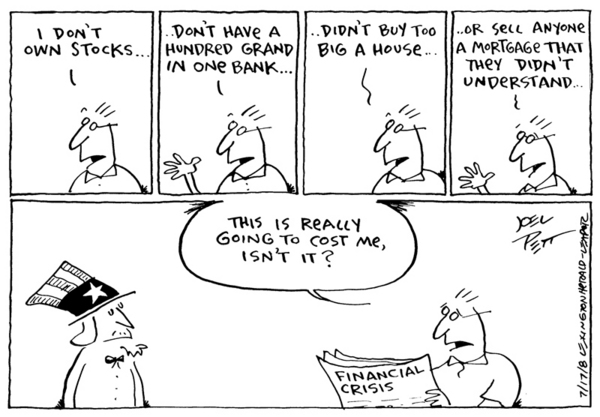
As I've written here on this blog before, our public policy has come closer and closer to engendering moral hazards. Now, this statement has come to a sick and twisted fruition. The cause of this putried flowering is the confluence of two individual factors. The first, is President-elect Barack Obama's pledge to help the ailinig auto industry. Already bleeding money like it needs a tournequet and considering passing another series of economic stimulus packages, the deficit is already such a theoretical number that adding to it won't make much of a difference. The second is another set of behaviors that, besides the aforementioned moral hazard, are morally questionable in other ways. General Motors is burning cash like it's needed to power plant machinery lost $7.35 per share in its latest report. Furthermore, this cash crunch is putting the company in the position where it will no longer be able to fund regular operations. However, instead of consider options like marginal spending decreases, or bankruptcy, the consequences of which CEO Rick Wagoner says would be "dire", he is waiting for President Obama to pull out the checkbook and write a check to the auto industry. After all, the financial industry is in the process of receiving checks without any strings attached, so why shouldn't the Big Three, also? I'm sure Rick is also already beginning to plan how he is going to spend the bonus that he no doubt will feel he earned because he drove the company into the ground so hard and fast that the government needed to bail it out or face political consequences.  Herein lies the moral hazard and the real cost of the Emergency Economic Stabilization Act. Instead of engaging in normal business practices that would help shore up the bottom line, such as closing additional plants and laying off hourly workers, or even declaring bankruptcy and arresting the further deterioration in its credit rating, a company that is potentially too big to fail, is probably going to be able to get a handout from the federal government. So, instead of receiving the punishment of the markets for not balancing its liabilities and assets properly, and for not developing products that the public is willing to purchase, a company is instead able to receive the public's money in the form of a handout, probably without any strings attached.  

Thursday, November 06, 2008

The Afterglow


I have made the analogy before that the campaign was like being hit on by a drunken sociopath. In the aftermath of the election it seems even more so with various special interest groups and media outlets remembering various promises made by Obama while on the road to the White House. They seem like an expectant lover on the morning after, hopeful that this impulsive decision to get in bed with this beautiful person who said all the right things will turn into a healthy relationship. All the while the recipient of the lover's attention hurriedly prepares to move on with his agenda while assuring the lover that, "that was all pillow talk baby." We can at least hope that Obama doesn't spurn the voters like a one night stand. But he is a politician and I won't hold my breath.

John Stewart made the observation to Obama that the country isn't what it was when he started this race. Truly Obama is inheriting a sloppy shit sandwich from one of the most hated presidents in history. Unfortunately for the discontent, Bush is scheduled to leave office and they will loose a symbol of everything they dislike about U.S. policy. But the problems he created will remain. What happens if Obama fails? Do we loose the meager gains we have made in race relations? Does the country swing wildly back to the politically extreme right? Will there be much left of the country after four years if he can't get a hold on these various crises?

Parts of the country started to reflect Bush's low approval ratings by going blue this election. My question is whether these states who were red in 2004 have an indelible sin on them for causing the last 4 years of unnecessary downward spiraling of the nation. Ohio and Pennsylvania, I am looking at you.

As usual, I have nothing positive to say.

Monday, November 03, 2008

The Ben Franklin Report: Strains in the Economy

With the latest manufacturing data from the United States showing even more signs of contraction, one of the few thigns that can be said for certain about the overall situation, is that what might have been limited to the financial sector is clearly affecting the very basic sectors of the economy. Also, those were predicting that this affair was going to be a minor correction that would pass in a quarter or at most two, have been revealed as having played a guessing game, as the crisis is instead shaping up to be the worst economic crisis in almost a century. 

Manifestations of the problems are appearing in sales reports of the auto industry, where all of the manufacturers were hit with double-digit drops in sales, especially trucks. On Wall Street, too, there are signs as Circuit City has received a delisting notification from the New York Stock Exchange, and plans to close 155 stores as its death spiral continues to get tighter and tighter. 

Part of the misdirection that was at the heart of the financial crisis is coming unwound, as investors who bought notes from the now defunct Lehman Brothers that were promised to be sound investments worth of inclusion in retirement investment portfolios are now revealed to be worth only pennies on the dollar. Regulators are going to investgiate, but unfortunately, due to the counter-terrorism priorities of the Bush Administration, the FBI has been left critically short-handed as they try to investigate the myriad economic crimes and financial fraud. School districts in Wisconsin were caught up in their own form of financial mismanagement. Buying supposedly safe investments, the now infamous C.D.O.s, school boards all over the state are facing the prospect of cutting services in order to meet financial obligations from the defaults of various corporations.

Strains are also being seen on the macro scale, as the primary contributor to American GDP, the Federal Government, has announced plans to finance the largest budget deficit in history. The government itself won't put a number on how much the deficit will be exactly, but estimated that the total amount of bonds issued would be approximately $550 Billion for the October-December period, including $300 Billion for Federal Reserve liquidity operations. Analysts in the field estimate that the government's borrowing needs for the next fiscal year, which began in August, will total up to $2.1 Trillion. This number stems from funding the $850 Billion deficit projected in the Federal Budget, and approximately $500 Billion to further reinforce the Fed's liquidity operations of the amalgram soup, and the remainder going to roll over securities from state and local governments which are expected to see a significant drop in demand over the next year. The budget deficit is so large partly in thanks to deteriorating economic conditions and the $700 Billion bailout package passed by Congress against almost every economist's better judgment, but doesn't factor in whatever additional stimulus proposal will be passed by the Congress during the lame duck period following the election. 

On the micro scale, individual homeowners and families are also showing severe signs of strain. Throughout the country, but particularly in areas that are hardest hit by the mortgage crisis, more nad more homes are going 'underwater' to use the industry phrase. That is to say, about 1 in 5 of all homes in American are worth less than the balance of the mortgage the homeowner is paying. Families are also having a harder time making ends meet with their utility bills, also. As further evidence, about 44% of families are living paycheck to paycheck, and about 48% have less than $5,000 in liquid assets. So, in the event of a family emergency, medical or otherwise, very few would have any options, especially with bank lending still not an option, despite the Treasury's and Federal Reserve's efforts.

There is no shortage of people who are ready to criticize the Treasury and the Federal Reserve for their management of this crisis and their willingness to bail out institutions that were threatening to go bankrupt. A Nobel Prize-winning economist Robert J. Aumann predicts that more banks and insurance companies will go under because of moral hazard and the lack of consequence. Others say that deflation is the order of the day, also brought about by the various interventions in the free market. My question has been, since this crisis started, where were those in the position to do something about this problem when it started becoming apparent? Why weren't more authorities, for lack of a better word, willing to stand up and make warnings? Unfortunately, someone who is such a position is also at a loss for why pronouncements against the general consensus come in whispers, rather than shouts. 

I'll leave off with the latest scary charts from the Federal Resreve of St. Louis. Good night and good luck.


Click on the charts to see them at full size.


The Dragon is Out of Breath


As such a key part of the processes of globalization which have developed our global economy in the past few decades, the manufacturers of China could not hope to escape the deletrious effects of the global economic crisis. As demand falls all over the world for finished manufactured products, Chinese factories have been hard-hit. Although most economic data coming out of China is stir-fried and seasoned by government officials, the monthly manufacturer's survey is one number that is seen as reliable, and in the past couple of months, worrisome. What could once have been explained away as the slowing down of manufacturing during the Olympic Games is now something far worse. After two back to back contractions of this Chinese Manufacturers Purchasing Managers Index (or PM Index), it is clear that this is no longer simply a statistical abberation or short-term correction. 

The problems are becoming apparent in very embarrassing ways. For instance, in the fourth-largest city, Chongqing, taxi cab drivers went on strike to protest the depreciation of what amounts to their standards of living.  Increased competition, fuel shortages, and inflation have driven down the value of their fares, which have not kept up with inflation. Showing the critical nature of cab drivers in the PRC, the strikers demands were met after only one day. 

More embarrassing to the ruling party are cases of party officials fleeing the country with embezzled funds, which according to reports total at least $100 billion. One official by the name of Yang Xianghong left a delegation in Paris under the pretense of visiting his daughter. A similar phenomenon is also rearing its ugly head in the private sector, as factory owners who find themselves unable to pay off obligations sell off everything they can't take with them and disappear, literally overnight, of course taking time to destroy all records on the way out. Behavior like this is perfectly expectable when considering information asymmetry. For instance, the factory owner who realizes how bankrupt his company is before anyone else finds out, will probably take whatever he can get out of his investment of time and money and leave before accountability catches up. party officials likewise have a particular interest. In times of economic distress, it is easy to imagine why enforcement of laws governing economic crimes, such as embezzlement and other forms of corruption, would become much more strict. As China doesn't have very many extradition treaties with other countries due to its continued use of the death penalty,  officials can live very well for a while, if not for the rest of their lives, off of ill-gotten gains, and of course, the more the amount of gains, the longer the official is able to pay legal fees and perhaps bribes to lengthen the extradition process or remove it as a possibility altogether.

In China's third-largest city where I live, Tianjin, the economic problems are slow to be revealed. Although this city depends on manufacturing for a great deal of its economic activity, development here was a key point in the latest 5-year economic development plan. So while the rest of China may be wilting from the lack of fresh orders from overseas and paltry domestic consumption, Tianjin is still booming. For instance, even though China is entering the downward cycle in the property sector as evidenced by the proliferation of empty buildings for sale and ret, just as occured in the United States in the past two years, I can see five separate large-scale construction projects just from my apartment windows. Clearly, in a nation as large as China, economic slowdowns are uneven at best.